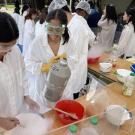
Professor of Teaching Jason White is reimagining a chemical engineering course to create a classroom that is welcoming and accessible for neurodivergent learners. Discover how he is using Universal Design for Learning to make engineering education inclusive for all.
A UC Davis pre-college program helped Sofia Jordana discover her passion for chemical engineering. Now a second-year undergraduate, she’s all in, leading AIChE events and showing how enthusiasm and curiosity can shape an engineering journey.
Designed for students without an engineering background, a new master’s program at UC Davis prepares graduates to meet the rising demand for the workforce across energy, biotech and advanced manufacturing.
Chemical engineering is the branch of engineering that combines principles of chemistry, physics, math and biology to develop processes and equipment for manufacturing chemicals, fuel, drugs, food and many other products.
UC Davis researchers partnered with Oak Ridge National Laboratory to design a new device that can use neutrons to measure molecules in optically excited states. It's a potential game-changer to study materials that will increase the efficiency of photovoltaic solar cells.
A professor and alum of UC Davis collaborated with researchers at Oak Ridge National Laboratory to develop a rotating sample holder that enables new types of neuron experiments.
From career advancement to unique social events to their revered presence at Picnic Day, the American Institute of Chemical Engineers at the University of California, Davis, has something to offer every engineering student.
Tonya Kuhl, chair of the chemical engineering department and co-director of the UC Davis Coffee Center, exchanges coffee and chemical engineering research and knowledge with Osaka University, a UC Davis Global Knowledge Partner.
Glaucia Helena Carvalho do Prado reflects on her takeaways from a DEI faculty workshop diving into disruptive speech and how to make the classroom a safe learning environment for all.
The Ahn Lab in the Department of Chemical Engineering is pioneering groundbreaking tools for new research that could lead to more effective pain therapies.